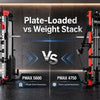
Plate-Loaded vs Weight Stack: Key Home Gym Differences
Introduction – The Dilemma
Scenario Setup: You're planning your home gym and see two similar‑looking machines. One costs less but requires manually loading and unloading weight plates every time you change resistance. The other costs more but lets you switch weight with just a pin. The dilemma: pay more for convenience, or save money and do the work yourself?
Pain Points: Limited budget, limited space. Choosing the wrong equipment could lead to inefficient training or blowing your budget on features you don't actually need.
The Hook: Plate‑loaded machines are cheaper, but you'll be bending over to change plates every set. Weight‑stack machines are pricier, but their built‑in weight limit might not be enough as you get stronger.
What Are Plate‑Loaded Home Gym Machines and How Do They Work?
Definition: Strength equipment that requires manually loading weight plates. Users slide standard Olympic plates (or other commercial plates) onto the machine's loading horns and adjust resistance by adding or removing plates.
How They Work: Weight plates sit directly on the machine's loading horns, with resistance typically transferred through a lever or pulley system. The resistance curve feels closer to free weights – what you load is what you lift. The mechanical structure is simple: remove a weight stack, and you remove hundreds of potential failure points.
Biomechanical Characteristics: The weight is "real." Plate‑loaded machines usually deliver a more "honest" force curve, providing consistent resistance output throughout the range of motion. This makes them popular among experienced lifters who want to feel every kilogram.
Typical Models: RitKeep PMAX‑4750 (plate‑loaded design).
Price Range: $600–$1,800 (entry to mid‑level)
Footprint Reference: Depends on the specific model; some plate‑loaded units without a weight‑stack tower can significantly reduce depth.
「RitKeep Product Spotlight」 PMAX‑4750 – The Value Pick for Plate‑Loaded Home Gyms
If you're looking for a classic All-in-one functional trainer plate loaded home gym machine, the RitKeep PMAX‑4750 deserves a close look. It uses a plate‑loaded design, so you can load your own Olympic plates directly onto the machine – no extra cost for built‑in weight stacks.
Key features:
- Switchable 1:1 and 2:1 pulley ratios – Use 1:1 for heavy rows and lat pulldowns, then flip to 2:1 for high‑rep flyes and face pulls.
- Linear‑bearing guide rails – Ensure the cable system stays smooth and free of sticking or jerking, even under heavy loads.
- Compact depth – Without a rear weight‑stack tower, the PMAX‑4750 saves valuable floor space.
- 6‑in‑1 design – Smith machine, dual‑cable crossovers, pull‑up station, dip station, low row, and power rack all in one footprint.

What Are Weight‑Stack Home Gym Machines and How Do They Work?
Definition: Strength equipment equipped with a built‑in weight stack. Users adjust resistance quickly by inserting a selector pin. The weight stack is an integrated component, requiring no additional weight plates.
How They Work: The weight stack connects to the handles via cables and a pulley system. The weight stack pin determines how many weight plates are lifted. Some models feature a dual weight stack design, allowing independent resistance adjustment on each side – perfect for cable crossovers and unilateral training.
The Core Convenience: Change resistance in seconds by simply pulling the pin and reinserting it. No bending over, no carrying plates. This makes weight‑stack machines ideal for multiple users, circuit training, or anyone who values training efficiency.
Typical Models: RitKeep PMAX‑5600 (dual weight stacks), RitKeep ANVIL S1 (rear‑mounted dual stacks), RitKeep Nimitz N1 (counterbalanced with dual stacks).
Price Range: $1,200–$3,500 (entry to mid‑level)
Footprint Reference: Typically requires more depth due to the vertical weight‑stack tower, demanding additional rear clearance.
「RitKeep Product Spotlight」 PMAX‑5600 – The Weight‑Stack All‑Rounder
If you value the fastest possible weight changes and effortless operation, the PMAX‑5600 is a standout choice among weight‑stack machines. It features dual built‑in weight stacks, letting you adjust resistance in seconds with just a selector pin. You can even upgrade the stack from 150 kg total to 190 kg, or use optional add‑on pegs to store extra plates on top of the stacks.
Key features:
- Dual 75 kg weight stacks (150 kg total, upgradeable to 190 kg) – Independent adjustment per side, perfect for cable crossovers and unilateral work.
- 2:1 pulley ratio – Longer cable travel and smoother motion for functional and isolation exercises.
- 23 cable height adjustment positions – Fine‑tune starting height to match your body and exercise.
- Enclosed weight stacks with protective shrouds – Safer for households with children or pets.
- All‑in‑one design – Smith machine, functional trainer, pull‑up bar, dip station, low row, and power rack.
The PMAX‑5600 is ideal for home gyms where convenience, shared use, and a clean, plate‑free environment are top priorities.

Additional weight‑stack models in the RitKeep lineup:
- ANVIL S1 – Rear‑mounted dual stacks in a super‑compact 145 cm depth, with a no‑setup lat pulldown/low row system.
- Nimitz N1 – Counterbalanced Smith machine with dual 75 kg stacks and switchable 1:1/2:1 pulley ratios. The N1 Pro adds add‑on plate pegs for up to 100 kg of extra resistance (solving the "weight stack not heavy enough" problem – see Part 6).
The Core Difference – Quick Comparison Table
| Comparison Dimension | Plate‑Loaded | Weight Stack |
|---|---|---|
| Resistance Adjustment | Manually load/unload weight plates | Select built‑in weight plates with a pin |
| Resistance "Ceiling" | Depends on horn length – theoretically unlimited | Limited by stack size (e.g., 68–91 kg per side) |
| Increment Size | As fine as 1 kg (if you have the plates) | Limited by minimum plate increment (usually 5–9 kg) |
| Muscle Activation | Higher – resistance curve closer to free weights, more stabilizer engagement | More controlled – fixed path, less stabilizer engagement |
| Ease of Use | Slower – must handle plates each change | Extremely fast – just pull and reinsert the pin |
| Price Range | Lower – no cost for an integrated weight stack | Higher – weight stacks, cables, and pulley systems add cost |
| Space Requirements | Depends on model; often less depth without weight stack tower | Weight stack tower adds depth; requires dedicated clearance behind |
| Maintenance Needs | Lower – simpler structure, fewer failure points | Higher – cables and pulley systems require regular inspection |
| Ideal User | Experienced lifters, strength‑advanced users, those who already own plates | Beginners, families sharing the gym, those prioritizing convenience |
| Typical Models | RitKeep PMAX‑4750 | RitKeep PMAX‑5600, ANVIL S1, Nimitz N1 |
Plate‑Loaded Machines – Pros & Cons
Pros:
- Theoretically No Weight Limit – You can load as many plates as the horn can hold, perfect for continuously progressing strength athletes.
- Fine‑Tuned Progressive Overload – Mix and match small plates (1 kg, 2.5 kg) to achieve precise, incremental load increases. This is especially valuable for smaller muscle groups like rear delts or biceps.
- More "Real" Resistance Curve – Without complex cam systems, the resistance feels closer to free weights – more "honest" for the lifter.
- Simple Structure, Minimal Maintenance – No complex weight stacks, cables, and pulley systems mean fewer potential failures and greater long‑term reliability. One less component to break = one less headache.
- Budget‑Friendly – If you already own weight plates, you don't need to pay for another set of iron. Sharing existing plates across machines can save you thousands.
- Some Models Save Space – Plate‑loaded models without a vertical weight tower (like the PMAX‑4750) can have a significantly reduced depth.
Cons:
- Slower Weight Changes – Adding or removing plates for every adjustment is tedious, reducing efficiency during supersets or circuit training.
- Extra Storage Space Needed – Plates can't be left scattered on the floor; you'll need dedicated storage racks or space, increasing the overall footprint.
- Potential Plate Wear – Repeated sliding on and off the horn can enlarge the center hole of plates over time, affecting stability and fit accuracy.
- Physically Demanding Adjustments – Carrying multiple plates for every change adds unnecessary physical fatigue over a long workout.
- Plate "Stacking" Interference at Heavy Loads – When the horn is fully loaded, plates may touch or rub against each other, impacting movement smoothness.

Weight Stack Machines – Pros & Cons
Pros:
- Extremely Fast Weight Changes – Just pull the pin and reinsert it into the target slot – done in seconds, with no metal plates to handle. Ideal for circuit training, superset exercises, or shared use.
- Clear Weight Values – Weight plates typically have the weight printed on them, eliminating the risk of loading errors.
- No Extra Plate Storage – The weight stack is integrated into the machine, so you don't need separate storage racks.
- Ultra‑Simple Operation – Sit down, set the pin, start training – no extra physical preparation steps.
- Enclosed Weight Stack with Shields – Moving parts are enclosed, making it safer for households with children or pets.
Cons:
- Higher Price – The weight stack (especially dual‑stack designs) significantly drives up the machine's cost, often costing hundreds to thousands more than a comparable plate‑loaded model.
- Fixed Weight Limit – The maximum resistance is predetermined at the factory. Once you can easily rep out the entire stack, the machine risks becoming a clothes hanger.
- Larger Increment Jumps – The smallest plate jump is usually 5–9 kg. For smaller muscle groups like shoulders or arms, this jump can be too large, leading to a "too light to be effective, too heavy to perform" plateau.
- Larger Footprint – The weight stack tower significantly increases depth, demanding more space.
- More Potential Failure Points – Multiple components (cables, pulleys, guide rods) mean more points of potential wear; cables need regular inspection and pulleys need lubrication.

「Addressing the Weight‑Stack Ceiling Problem – N1 Pro Solution」
A common concern with weight stack machines is that advanced lifters will eventually max them out. The RitKeep Nimitz N1 Pro solves this directly. While the standard N1 features dual 68 kg steel weight stacks (switchable 1:1/2:1 pulley ratios, counterbalanced Smith bar, and industrial‑grade linear bearings), the N1 Pro adds add‑on weight pegs that allow you to load up to 100 kg of additional plates on top of the built‑in stacks.
This means you get all the convenience of a weight‑stack machine – fast pin changes, enclosed stacks, smooth cable feel – plus the ability to increase total resistance well beyond 200 kg when you need it. The N1 Pro is more expensive than the PMAX‑5600, but for lifters who need both convenience and an ultra‑high weight ceiling, it's the ultimate solution. No more "I've maxed out the stack" frustration.
Muscle Activation & Strength Progression – Which Builds More Muscle?
This is one of the biggest questions for fitness enthusiasts. From a pure hypertrophy and strength development standpoint, plate‑loaded machines generally hold a slight edge.
Differences in Muscle Activation: Plate‑loaded machines more closely mimic free‑weight training, requiring greater stabilizer muscle engagement to control the movement path and posture. This additional stabilization demand can lead to higher total muscle fiber recruitment.
Progressive Overload Flexibility: You can increase weight in tiny increments (1 kg, 2.5 kg) with plate‑loaded machines, allowing for finer progressive overload. Weight stacks have larger minimum jumps, often causing a "too light to stimulate, too heavy to execute" sticking point.
The Ceiling Issue: Advanced lifters who continually gain strength will eventually max out a weight stack, whereas a plate‑loaded machine's limit only depends on how many plates you own. (The N1 Pro's add‑on pegs largely solve this for weight‑stack fans.)
The Essence of Muscle Building: Regardless of machine type, progressive overload and training consistency are the true drivers of muscle growth. Weight‑stack machines can still deliver excellent hypertrophy results, especially for safe, beginner‑friendly progression.
Conclusion: Goal is purely maximizing muscle growth with existing training experience → Plate‑loaded has a slight advantage. Goal is safe, convenient, consistent training → The difference is negligible. Either system can build an impressive physique when used correctly.
Common Myths About Plate‑Loaded vs Weight Stack Machines
Myth #1: "Weight stack machines don't build as much muscle as free weights."
Reality: As long as you apply progressive overload and train close to failure, the hypertrophic effect of a weight‑stack machine is not significantly different from plate‑loaded or free‑weight equivalents. Training intensity and volume are what matter most – not whether the resistance comes from a stack or loose plates.
Myth #2: "Plate‑loaded machines are too slow for intense training."
Reality: By pre‑planning plate combinations, using quick‑release collars, or leveraging dual independent loading horns, you can compress change times to 15–30 seconds – perfectly adequate for most training tempos. Supersets can be structured to use the same weight across multiple movements.
Myth #3: "Weight stacks aren't heavy enough for advanced lifters."
Reality: You can increase intensity through unilateral training, slowing down the eccentric phase, increasing reps, or adding resistance bands. Furthermore, most home gym dual stacks (e.g., 75 kg per side ×2 = 150 kg total) are sufficient for intermediate to advanced training. And as noted above, the Nimitz N1 Pro eliminates the ceiling problem entirely with add‑on plate pegs.
Myth #4: "Plate‑loaded machines are always cheaper."
Reality: If you don't already own plates, purchasing 150–190 kg of Olympic plates and a storage rack at once can easily exceed the cost of a mid‑range weight‑stack machine. Always compare total cost – machine + plates + storage + shipping – not just the machine's price tag.
Plate‑Loaded vs Weight Stack – Cost, Space & Storage Comparison + Product Overview
Price Positioning:
- Plate‑Loaded: $600–$1,800
- Weight Stack: $1,200–$3,500
Space Requirements:
- Plate‑Loaded: Can be shallower if no weight tower is present, but requires additional area for plate storage.
- Weight Stack: The weight tower significantly increases depth, but no loose plate storage is needed.
RitKeep Product Line Core Specs at a Glance
| Model | Type | Key Features | Best For |
|---|---|---|---|
| PMAX-4750 | Plate‑loaded (Smith + functional trainer) | Switchable 1:1 & 2:1; linear bearings; 6‑in‑1; compact depth | Already own plates; want max weight ceiling; budget‑minded |
| Destroyer M10 | Free‑weight power rack + 2:1 cables (no Smith) | up to 544 kg capacity for safety arms; 15 cable levels; 50×50 mm uprights | Prioritize free barbell training; don't need Smith safety |
| PMAX-5600 | Weight stack (Smith + functional trainer) | Dual 75 kg weight stacks (upgradable to 90kg); 2:1 ratio; 23 cable heights | Want fast changes; clean look; family shared use |
| ANVIL S1 | Weight stack (Smith + functional trainer) | Dual rear stacks; 145 cm depth; no‑setup lat/low row | Space‑tight but need full weight‑stack functionality |
| Nimitz N1 / N1 Pro | Weight stack (counterbalanced Smith + functional trainer) | Dual 70 kg stacks; switchable 1:1 & 2:1 pulley ratios; Pro adds +100 kg plate pegs | Want both convenience AND an ultra‑high weight ceiling |
Which One Should You Choose? – Buying Decision Guide
Choose a Plate‑Loaded Machine (e.g., PMAX‑4750) if:
- You already own a decent set of weight plates (saving cost)
- Your strength is steadily increasing and you don't want to be limited by a weight‑stack ceiling
- You don't mind handling plates during weight changes
- You train at a high intensity and need small weight increments
- Your budget is tighter, and you want to invest in core functionality over extras
Choose a Weight‑Stack Machine (e.g., PMAX‑5600, ANVIL S1, Nimitz N1) if:
- Your training time is limited and you value the fastest possible weight changes
- Multiple people share the home gym and you want the simplest possible operation
- You don't have a plate collection and buying a weight‑stack machine is a one‑stop solution
- You prefer a smooth cable feel and the safety of an enclosed weight stack
- Your current strength level is far below the stack's maximum (or you're willing to buy the N1 Pro for future‑proofing)
- Your space allows for the extra depth of the weight stack tower (or you choose the compact S1)
Part 11: Frequently Asked Questions
Q1: Which builds more muscle, plate‑loaded or weight‑stack machines?
A: Both can build significant muscle. Plate‑loaded machines may offer a slight edge in stabilizer activation and smaller increment jumps, but weight‑stack machines provide convenience that can lead to more consistent training – which often matters more in the long run.
Q2: What if the weight stack isn't heavy enough?
A: You have several options: train unilaterally (one arm/leg at a time), slow down the eccentric phase, add resistance bands, or increase reps. For a permanent solution, the Nimitz N1 Pro allows you to add up to 100 kg of extra plates on top of the built‑in stacks, effectively removing the ceiling.
Q3: I already own weight plates – should I prioritize a plate‑loaded machine?
A: Yes, a plate‑loaded machine like the PMAX‑4750 is often the most cost‑effective choice. You're not paying for another set of iron, and you get unlimited weight progression.
Q4: Are plate‑loaded weight changes really that slow?
A: Not necessarily. With practice and pre‑planning, most users can change plates in 20–30 seconds – perfectly fine for straight sets. For circuits or supersets, a weight‑stack machine is faster.
Q5: How high are the maintenance costs for weight‑stack machines?
A: Low for normal home use. Cables may need replacement every 2–3 years ($20–50 per cable), and occasional pulley lubrication is simple (using silicone spray or light machine oil). Most home users never experience a failure. Inspect cables for fraying every few months – that's the main wear item. Compared to the convenience gained, the maintenance burden is minimal.
Q6: Will the center hole of my plates wear out over time on a plate‑loaded machine?
A: Over many years of heavy use, yes – but this is rare in home gyms. Using plastic or rubber inserts on loading horns (if the machine provides them) reduces wear. Most home lifters will never notice significant plate degradation.
Conclusion & Action Summary – Final Decision Recap
Plate‑Loaded Machines (e.g., PMAX‑4750):
- Lower upfront cost (especially if you already own plates)
- No weight ceiling – load as heavy as you want
- Simple, low‑maintenance structure
- Slower weight changes and need extra storage space
- Best suited for advanced lifters and those who already have a plate collection
Weight‑Stack Machines (e.g., PMAX‑5600, ANVIL S1, Nimitz N1):
- Extremely fast weight changes – just pull and reinsert the pin
- Ultra‑simple operation – great for families and shared use
- No loose plates to store – everything is enclosed
- Higher cost, fixed weight limit (solved by N1 Pro's add‑on pegs)
- Best suited for beginners, families, and anyone who values convenience
Final Recommendations:
- Take stock of the weight plates you already own. If you have 150+ kg of plates, plate‑loaded makes strong financial sense.
- Assess your strength level. Are you close to maxing out a 70–90 kg stack? If yes, consider plate‑loaded or the N1 Pro.
- Calculate the time cost of changing plates. If you run circuit training or superset frequently, a weight‑stack machine will save noticeable time every session.
Match your RitKeep model:
- Strength progression, own plates, budget‑minded → PMAX‑4750
- Free‑weight only, no Smith needed → Destroyer M10
- Fast changes, family use, standard weight needs → PMAX‑5600
- Extremely tight space but want weight stacks → ANVIL S1
- Want both convenience AND an ultra‑high weight ceiling → Nimitz N1 / N1 Pro