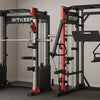
Smith Machine Home Gym Guide- Is It Worth It
Introduction
Are you dreaming of a home gym but feel overwhelmed by equipment choices? You walk into a showroom or scroll online and keep seeing this bulky contraption with rails and cables — the Smith machine. You wonder: Do I actually need this, or is it just taking up space?
Here's the frustration: you want to train safely by yourself, but your budget and space are limited. You've heard people say Smith machines are "cheating," yet others swear by them for building muscle safely at home. The answer isn't simple — there's genuine debate among home gym builders.
This guide clears up the confusion. You'll learn what a Smith machine is, how it works (using real products from RitKeep as examples), its pros and cons, who it's for, costs, space needs, and — most importantly — whether it's worth buying for your home gym. We'll also help you decide between the Nimitz N1, PMAX 5600, ANVIL S1, PMAX 4750, and Destroyer M10.
What Is a Smith Machine?
A Smith machine is a strength training apparatus with a barbell fixed between two vertical steel rails. This guided design allows the bar to move only up and down (or along a slight angle), eliminating the need to balance the weight. Built-in locking hooks let you rack the bar at any point, making solo training significantly safer.
Two main types: Vertical rail Smith machines move straight up and down. Angled (counterbalanced) Smith machines tilt slightly (7–15 degrees) to better mimic natural human movement. Modern counterbalanced systems also use precision linear bearings instead of older nylon bushings, resulting in noticeably smoother, quieter operation under heavy loads.
The Nimitz N1 from RitKeep represents the current gold standard for guided Smith systems. Its counterbalanced Smith system connects directly to the weight stacks, reducing the starting weight of the bar for smooth, effortless lifting. Integrated industrial-grade precision linear bearings ensure smooth, guided motion under any load — far superior to cheaper nylon bushings that can bind or stutter during heavy lifts. In practice, even when loading the N1 to near its 250kg max, the Smith bar glides with no lateral wobble or grinding.
The history of the Smith machine traces back to fitness pioneer Jack LaLanne, who reportedly invented a version in the 1950s to help his clients train safely. The design was later refined and popularized by Rudy Smith, giving the machine its name.
Today, the Smith machine has evolved into integrated "all-in-one" systems. Modern machines like the RitKeep PMAX 5600 and ANVIL S1 combine the Smith mechanism with built-in cable pulleys, pull-up bars, low row stations, and dip stations into a single, space-efficient unit. Instead of buying a separate squat rack, functional trainer, and lat pulldown station, you get six machines in one footprint.

Smith Machine vs Free Weights vs Squat Rack
| Comparison Aspect | Smith Machine | Free Weights | Squat Rack / Power Rack |
|---|---|---|---|
| Movement Path | Fixed vertical/angled rails | Completely free | Free |
| Muscle Activation | Prime movers only; minimal stabilizers | Full-body stabilization | Full-body stabilization |
| Safety for Solo Training | High – built-in locks | Low – requires spotter | Moderate – needs safety arms |
| Learning Curve | Beginner-friendly | Steeper | Moderate |
| Price Range | $800 - $4,000+ | $200 - $1,500 | $300 - $1,500 |
| Best For | Hypertrophy, isolation, safe solo training | Strength, power, functional fitness | Compound lifts, powerlifting |
The key takeaway: A Smith machine trades freedom of motion for safety and control. Free weights recruit more stabilizer muscles — research shows significantly higher EMG activity in stabilizers during free weight exercises. However, the fixed path of the Smith machine allows you to push closer to failure safely and target specific muscles with greater isolation. Neither is "better" overall; it depends on your goals and whether you have a reliable training partner.
Pros – 5 Major Advantages
1. Safety – Train Alone Without a Spotter
Smith machines are invaluable for solo lifters. Built-in rotating hooks let you rack the bar at any point during a rep — something impossible with a free barbell. If you fail during a heavy squat or bench press, simply twist the bar to lock it into the rails.
RitKeep examples: The PMAX 4750 features an integrated safety locking mechanism. The Nimitz N1 offers 12 locking positions for bench presses, squats, rows, and more.

2. Stability and Control – Beginner-Friendly
The Smith machine's guided bar removes the balance variable, letting you focus entirely on your movement pattern and muscle engagement. This builds confidence and proper form before transitioning to free weights.
RitKeep examples: The PMAX 5600 delivers a stable Smith experience in a complete home gym package. The ANVIL S1's 14-gauge steel frame provides excellent stability under its 1000 kg total capacity.
What users say: “The N1’s linear bearings are ridiculously smooth — zero stutter, zero lateral play. It honestly feels better than the Smith machine at my old commercial gym.” – Alex M., verified N1 owner
3. Muscle Isolation – Ideal for Hypertrophy
Because the Smith machine stabilizes the bar for you, you can push closer to failure and focus entirely on stretching and contracting the target muscle. This makes it a powerful tool for muscle growth.
RitKeep examples: The Nimitz N1 features dual pulley ratios (1:1 and 2:1), allowing you to switch between heavy direct resistance for lat pulldowns and smoother, longer-travel resistance for flyes and crossovers. The ANVIL S1's Dual-Drive Pulley System delivers smooth, balanced resistance with a built-in lat pulldown that requires no setup — just sit down and train.

4. Great for Rehabilitation and Injury Recovery
The controlled environment of a Smith machine reduces the risk of uncontrolled movements that could aggravate an injury, allowing you to rebuild strength progressively. Physical therapists frequently use Smith machines for this reason.
RitKeep example: The PMAX 4750 and PMAX 5600 provide smooth, guided motion at accessible price points, letting you start at very low resistance.
5. Multi-Function & Space-Efficient (All-in-One Designs)
This is arguably the biggest selling point for home gyms. Modern all-in-one Smith machines integrate multiple functions into a single footprint.
RitKeep's all-in-one lineup (core features overview):
| Model | Key Feature | Best For |
|---|---|---|
| Nimitz N1 | Dual 70kg stacks, 1:1 & 2:1 ratios, 31 cable positions,Counterbalanced Smith System | Advanced lifters, commercial quality |
| PMAX 5600 | Dual 75kg stacks, 2:1 ratio | Value-conscious buyers |
| ANVIL S1 | Dual 75kg stacks, compact 139 cm depth | Space-limited setups |
| PMAX 4750 | Plate-loaded, 1:1 & 2:1 ratios | Budget-focused buyers |
| Destroyer M10 | Power rack + 2:1 cable crossover | Free-weight priority |
Each of these machines replaces multiple standalone equipment pieces — effectively delivering a "one machine, one home gym" solution.
Cons – 5 Major Limitations
1. Fixed Path Does Not Mimic Natural Movement Patterns
The human body doesn't move in perfectly straight lines. During a squat, the bar naturally travels in a slight arc. Vertical rails can force a linear path that may not align with your biomechanics. However, this doesn’t mean you can’t get an effective workout. By adjusting your stance width and foot placement, you can shift emphasis and still target your intended muscles with precision. For specific technique tweaks, refer to Part 8: Best Exercises on a Smith Machine — small changes make a big difference.
The caveat: Modern Smith machines (like RitKeep's Nimitz N1 and ANVIL S1) use precision linear bearings for more fluid movement. However, for advanced lifters focused on competition training, a Smith machine cannot replace a free barbell.
2. Less Stabilizer Muscle Activation
This is the most cited criticism. Because the Smith machine stabilizes the weight for you, your core and smaller stabilizing muscles are less engaged. Over-reliance can lead to relative weakness in these areas. Research confirms free weight squats engage the full kinetic chain more effectively. Many coaches recommend using a Smith machine as a supplement to, not a replacement for, free weight training.
3. Not 100% Safe – Risks Still Exist
The fixed bar path can place the knees ahead of the toes during squats (increasing shear force) or put the shoulders in unnatural positions during bench presses. Additionally, if you fail while the bar is locked, you can still be pinned if you don't rotate it correctly.
Practical advice: Always test the locking mechanism with light weight first. Never assume the machine will "save you" automatically.
4. Higher Upfront Cost and Larger Footprint
A quality Smith machine with weight stacks is a significant investment — typically $1,500 to $4,000 — compared to a basic power rack and barbell set that might cost $500 to $1,000. All-in-one designs still require a dedicated footprint of roughly 20–30 square feet. RitKeep's range accommodates different budgets: The PMAX 4750 provides a plate-loaded entry point, while the Nimitz N1 represents the premium tier with 13-gauge steel and switchable pulley ratios.
5. "False Security" Risk – Encourages Lifting Too Heavy Too Early
Because a Smith machine "holds" the weight for you, it's tempting to load on more weight than your joints and connective tissues are ready for. This is particularly dangerous for beginners.
Real-world caution: Experienced lifters report that rehabbing injuries from Smith machines is not uncommon — users mistakenly felt the machine "protected" them while their form deteriorated unnoticed. Always prioritize proper technique. Practice with light weight first, record your sets, and never add weight simply because you can lock it out.
Who Is It For? – 3 Ideal User Profiles
Profile 1: Beginners or Those Returning from Injury/Rehab
The Smith machine provides a safe, controlled environment to rebuild movement patterns and confidence.
Recommended RitKeep models: PMAX 4750 – Plate-loaded design lets you start with the lightest possible resistance, adding weight in small, precise amounts. PMAX 5600 – Built-in dual weight stacks (150kg total, optional 190 kg) provide smooth, consistent resistance without handling loose plates. Both models combine multiple training functions, so you won't outgrow the machine as you progress.

Profile 2: Intermediate/Advanced Lifters Focused on Hypertrophy
For experienced lifters focused on muscle size, the Smith machine is invaluable for volume, drop sets, and fully fatiguing a muscle group.
Recommended RitKeep models: Nimitz N1 – Dual 70 kg steel stacks with switchable 1:1 and 2:1 pulley ratios. The N1 Pro adds weight pegs for up to 100 kg of additional resistance — crucial for advanced lifters who have surpassed built-in stack capacity. ANVIL S1 – Dual-Drive Pulley System combines both rear stacks (75kg each) to deliver true 1:1 resistance when full pulling power is needed, plus 2:1 for smooth reps. Supports unilateral training to correct muscle imbalances.
Profile 3: Solo Lifters with Limited Time, Space, or Gym Partners
If you train alone at odd hours and have limited floor space, an all-in-one Smith machine is the most practical solution.
Recommended RitKeep models: ANVIL S1 – Compact depth of just 139 cm fits in garages, basements, or spare bedrooms. Destroyer M10 – If you prefer free-weight training but still want cable functionality, the M10 provides a 15-level crossover cable system with a smooth 2:1 ratio, plus safety arms rated for 680 kg. At 138 cm wide × 107 cm deep, it's one of the most compact options.
Cost & Space Analysis + Detailed Buyer's Guide
General Price Ranges
Budget (under $1,000): Basic plate-loaded Smith machines, minimal cable functionality.
Mid-Range ($1,500 - $2,500): All-in-one units with dual weight stacks, functional trainer cables, 14-gauge steel.
High-End ($3,000 - $5,000+): Premium systems with 13-gauge steel, switchable pulley ratios, commercial-grade components.
Space Requirements
Most full-size all-in-one Smith machines require a width of 140–203 cm, a depth of 114–178 cm, and a height of 208–218 cm (allow 15–30 cm overhead clearance for pull-ups).
RitKeep space reference:
ANVIL S1: 139cm (D) x 203 cm (W) x 212 cm (H)
PMAX 4750: 172cm (D) x 201.9cm (W) x 211cm (H)
PMAX 5600: 151 cm (D) x 203 cm (W) x 219 cm (H)
Nimitz N1: 172cm (D) × 202cm (W) × 214.5cm (H)
Destroyer M10: 137 cm (D) x 138 cm (W) x 212 cm (H)
RitKeep Product Positioning Ladder
💎 NIMITZ N1 / N1 Pro - Commercial feel, 1:1 & 2:1 ratios, 13-gauge steel. Max weight expandability (N1 Pro adds 100kg)
⚡ ANVIL S1 - Ultra-compact depth, dual 75kg stacks, no-setup lat pulldown, 2:1 ratio
🔥 PMAX 5600 - Best value with built-in weight stacks, dual 75kg (optional 95kg each), 2:1 ratio
🏋️ DESTROYER M10 - Power rack + cable hybrid, free-weight priority, plate-loaded, 2:1 ratio
🏁 PMAX 4750 - Budget-friendly entry, 1:1 & 2:1 ratios, plate-loaded, up to 6-in-1 versatility
Detailed RitKeep Comparison Table
| Model | Est. Price | Steel / Weight | Pulley Ratio | Key Differentiator |
|---|---|---|---|---|
| PMAX 4750 | $ (Budget) | 14-gauge, plate-loaded | 1:1 & 2:1 | Lowest entry; up to 6-in-1 |
| Destroyer M10 | $ (Budget/Mid) | 14-gauge, plate-loaded | 2:1 only | Power rack + cable hybrid |
| PMAX 5600 | $$ (Mid) | 14-gauge, dual 75kg stacks | 2:1 only | Best value with weight stacks |
| ANVIL S1 | $$ (Mid) | 14-gauge, dual 75kg stacks | 1:1 & 2:1 | Ultra-compact; no-setup lat/low row |
| Nimitz N1/N1 Pro | $$$ (Premium) | 13-gauge, dual 70kg stacks + Pro add-on | 1:1 & 2:1 | Commercial quality; switchable ratios |
Alternative to buying a Smith machine: A power rack + barbell + spotter arms setup. The Destroyer M10 fits this description perfectly — it's a power rack with a cable system, not a Smith machine. Add an Olympic barbell and plates, and you have a complete free-weight home gym at a lower cost.
Best Exercises on a Smith Machine
Lower Body: Smith Squat & RDL Variations
Smith squat – Set bar at shoulder height, rest on upper traps, unlock, take a small step forward, squat down keeping chest up.
Smith Romanian deadlift (RDL) – Set bar at hip height, grip just outside legs. Hinge at hips, lower to mid-shin, drive through heels to return.
Upper Body Push: Bench Press & Overhead Press
Smith bench press – Lie on flat bench inside rack. Grip slightly wider than shoulder-width, lower to mid-chest, press back up. Use safety hooks to rack at any point.
Smith overhead press – Set bar at shoulder height with bench upright. Press directly overhead, lower with control.
Upper Body Pull: Bent-Over Row, Upright Row & Shrugs
Smith bent-over row – Set bar at knee height, hinge with flat back, row into waist, squeeze shoulder blades.
Upright row and shrugs – Close grip, pull to chin level for rows; for shrugs, lift and hold at top.
Is It Worth It for Your Home Gym?
Scenario-Based Evaluation
1. Primary fitness goals? Hypertrophy and safe solo training → YES. Powerlifting or sport-specific strength → Prioritize power rack + free weights.
2. How much space? Less than 3.7㎡ → ANVIL S1 (139cm depth). 5.5+㎡ → Any RitKeep model works.
3. Budget? Under $1,500 → PMAX 4750 or Destroyer M10. $1,500-$2,500 → PMAX 5600. $3,000+ → Nimitz N1.
4. Training level? Beginner → PMAX 4750 or PMAX 5600. Intermediate → ANVIL S1. Advanced → Nimitz N1/N1 Pro.
5. Train alone? → ANY Smith machine is a huge safety upgrade over free weights.
Making Your Decision: RitKeep Case Study
Choose Nimitz N1 if: Budget exceeds $3,000, want 1:1 & 2:1 ratios, need max weight potential, value 13-gauge steel.
Choose PMAX 5600 if: Budget $1,800-$2,400, want built-in 150 kg - 200 kg dual stacks, prefer weight stack convenience.
Choose ANVIL S1 if: Floor space is tight (139cm depth), want dual stacks in compact footprint, accept 2:1-only ratio.
Choose PMAX 4750 if: Tightest budget, want both 1:1 & 2:1 ratios, already own Olympic plates.
Choose Destroyer M10 if: Want power rack as primary (free-weight training) but still want cable crossover functionality.
Part 10: Final Takeaway – Action Steps
Before You Buy
- Test in person if possible – Run the Smith bar through full range.
- Inspect the welds – Consistent, clean, no cracks.
- Check rail smoothness – RitKeep's higher-end models use superior systems.
- Verify weight capacity – Ensure max load (900kg - 1200kg) exceeds your needs.
- Measure twice, buy once – Confirm ceiling height (min 213 cm), floor space, and clearance for loading plates.
If You Decide NOT to Buy a Smith Machine
A solid alternative home gym setup: Power rack (e.g., Destroyer M10 as a pure rack), Olympic barbell, weight plates, adjustable bench, spotter arms. This costs significantly less, prioritizes free-weight training, and builds superior stabilizer strength.
FAQ
Q: What is a Smith machine?
A: A Smith machine is a strength training device with a barbell fixed between two steel rails. The guided design eliminates balance concerns, and built-in safety hooks allow solo training.
Q: Can you squat on a Smith machine?
A: Yes — excellent for squats, especially for quad development and solo training. Fixed bar path lets you experiment with foot placement to shift emphasis.
Q: Is a Smith machine safer than free weights?
A: For solo training, yes — locking hooks prevent getting pinned. But the fixed path can stress shoulders and knees if your anatomy doesn't align.
Q: What's a good alternative to a Smith machine for home use?
A: A power rack + barbell + spotter arms. The RitKeep Destroyer M10 is built for exactly this — a power rack with a cable crossover system.
Q: Can beginners use a Smith machine?
A: Yes — many professionals recommend it. The guided bar removes balance concerns, letting beginners focus on form and muscle engagement.
Q: Is a Smith machine good for small home gyms?
A: Yes — if you choose a compact model. The ANVIL S1 has a depth of just 139 cm. The Destroyer M10 is even more compact at 138 cm deep × 107 cm wide.